It began with a single oscillating dot on a black screen. What followed was five decades of creativity, competition, cultural shift, and some of the most significant entertainment technology ever developed.
The Earliest Sparks: 1958–1971
Most people date the video game industry's birth to the early 1970s, but the real story starts earlier. In 1958, physicist William Higinbotham created a rudimentary tennis simulation on a Brookhaven National Laboratory oscilloscope — a device meant to demonstrate interactive technology, not sell units. He called it "Tennis for Two." It was never commercialised and Higinbotham never pursued a patent. At the time, it was a curiosity. In retrospect, it was the first spark.
The next significant step came from MIT student Steve Russell in 1962. Working with his colleagues, Russell built Spacewar! — a two-player combat game that ran on a PDP-1 minicomputer. It spread between university campuses via magnetic tapes, becoming one of the first widely played digital games. Spacewar! introduced concepts that persist in gaming today: real-time player input, competitive play, and gravity physics that could actually be exploited strategically.
These early games existed in an academic bubble. They weren't products. The leap to commercial viability would require hardware cheap enough to sell, and someone willing to take the financial risk.
The Arcade Era: 1972–1978
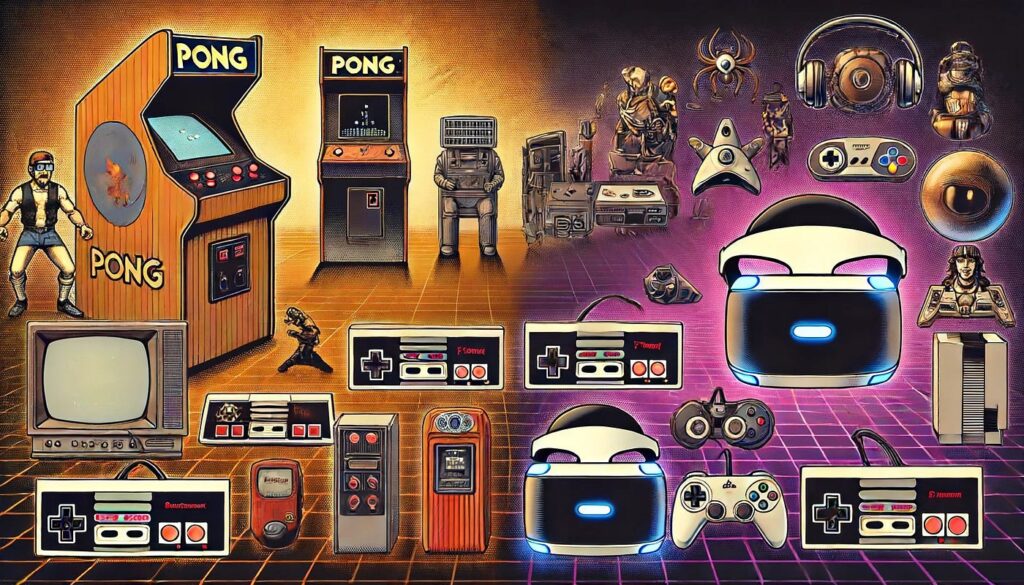
Atari's Pong, released in November 1972, is usually cited as the beginning of commercial gaming. The company's co-founder, Nolan Bushnell, had already tried to commercialise Spacewar! with a machine called Computer Space — it sold modestly, but operators found it too complex for casual bar and arcade customers. Pong stripped gaming back to its barest essentials: two paddles, a ball, and a score counter. It required no instruction. People understood it immediately.
The first Pong cabinet installed at a bar in Sunnyvale, California, reportedly broke down within days — not from malfunction, but because the coin box had overflowed. Atari had something genuinely compelling on their hands.
"Pong wasn't the most technically sophisticated game ever made. But it was the most accessible. It met people where they were." — from a retrospective interview with early Atari engineers
Throughout the mid-1970s, arcades multiplied across the United States and UK. Space Invaders arrived from Japan in 1978, courtesy of Taito, and changed the stakes considerably. It was the first game to feature a high score, encouraging players to return and beat their own records. More importantly, it introduced the concept of increasing difficulty — as players eliminated aliens, the remaining ones moved faster. A simple mechanic, but one that fundamentally altered how games were designed from that point forward.
The Home Console Arrives: 1977–1983
The Atari 2600, launched in 1977, was not the first home gaming console — that distinction belongs to the Magnavox Odyssey, released in 1972. But the 2600 was the first to achieve mass-market success. It used interchangeable cartridges, meaning players could buy new games without buying new hardware. The concept seems obvious now, but at the time it was a significant shift in how the industry worked.
The 2600 library grew quickly. By the early 1980s, it had hundreds of titles. Quality varied enormously — a problem that would come to define the era. Publishers flooded the market with hastily made games, capitalising on the system's popularity without investing in the experience of the player. The most notorious example was the tie-in game for E.T. the Extra-Terrestrial, developed in just five weeks for the 1982 holiday season. It became a symbol of an industry that had stopped respecting its audience.
The result was the crash of 1983. North American video game revenues dropped from $3.2 billion in 1983 to approximately $100 million by 1985. Retailers stopped dedicating shelf space to games. Many believed the home gaming market was a passing fad.
Nintendo's Rescue and the NES Era: 1985–1990
Nintendo had been developing the Famicom in Japan since 1983, where it performed strongly. Bringing it to a collapsed American market required careful marketing. The company deliberately positioned the NES as a toy rather than a gaming console, bundling it with R.O.B. (the Robotic Operating Buddy) to get it into toy stores that had banned games-related merchandise after the crash.
The gamble paid off. Super Mario Bros., which launched with the NES, became a reference point for what platform games could be. It had levels with genuine geographic logic, hidden rooms that rewarded curiosity, tight controls, and a difficulty curve that felt fair rather than punishing. It sold over 40 million copies and remains one of the most significant games ever made.
What Nintendo also introduced was rigorous quality control. The "Official Nintendo Seal of Quality" was printed on every licensed cartridge, a genuine attempt to prevent the low-quality flood that had destroyed Atari's reputation. Whether or not every licensed game was truly high quality, the signal mattered. Parents could trust the brand. That trust is one of the most enduring legacies of the NES era.
The Game Boy and Portable Gaming
In 1989, Nintendo released the Game Boy in Japan, North America, and eventually the UK. Designed by Gunpei Yokoi — who also created the Game & Watch series — the Game Boy used a reflective LCD screen that drained batteries slowly and was bundled with Tetris. The combination proved irresistible. Commuters, students, and young children who couldn't afford a home console could now have Nintendo games with them wherever they went.
The Game Boy was technically inferior to its competitors in almost every measurable way. The Atari Lynx and Sega Game Gear both offered colour screens and more powerful processors. Neither came close to matching Game Boy's sales. Battery life and the quality of available software mattered far more to consumers than technical specifications — a lesson that the industry would need to relearn several times.
The Console Wars: 1991–1995
Sega's Genesis (known as the Mega Drive in Europe) arrived in 1989, but it was Sonic the Hedgehog in 1991 that defined the machine's identity. Sega's marketing was aggressive and pointed directly at Nintendo's audience — "Genesis does what Nintendon't" was an actual advertising slogan. Sonic was faster, edgier, and clearly aimed at slightly older players. The console wars had begun.
What followed was arguably the most creatively fertile period in gaming history. Nintendo countered with the Super NES and titles like Super Mario World, F-Zero, and The Legend of Zelda: A Link to the Past. Sega released Streets of Rage, Mortal Kombat, and eventually Sonic 2. Both companies pushed their hardware to its limits in search of competitive advantage.
For those of us who grew up during this period, the rivalry felt genuinely personal. You were either a Nintendo kid or a Sega kid, and the choice said something about you — or at least, we believed it did. Looking back, the whole era was a gift. Competition between two strong companies produced some of the finest games ever made.
Into 3D: The 32-Bit Era and Beyond
The arrival of the PlayStation in 1994 (1995 in the UK) changed everything. Sony's machine used CD-ROM technology, enabling games with full voice acting, cinematic cutscenes, and storage capacities that cartridges simply couldn't match. It also brought gaming to an older demographic. The PlayStation wasn't marketed at children — it was marketed at teenagers and adults.
Nintendo's Nintendo 64, arriving in 1996, chose to stick with cartridges — a decision that cost them significant third-party support. But Super Mario 64 and The Legend of Zelda: Ocarina of Time demonstrated what 3D gaming could be when executed with exceptional design instincts. They remain two of the most highly regarded games ever made, and their influence can be traced through almost every 3D platformer and action-adventure game released since.
By the late 1990s, the era we now call "retro" was drawing to a close. The Sega Dreamcast launched in 1998, introducing online gaming to consoles for the first time. PlayStation 2 followed in 2000. The industry was moving into a new phase — and the games, consoles, and cultural moments of the preceding three decades were beginning their transformation from everyday technology into history.
Why Retro Gaming Still Matters
The games of the late 20th century aren't just nostalgia objects, though there's nothing wrong with nostalgia. They represent a period of extraordinary creativity, constrained by severe hardware limitations that forced designers to think laterally about what made a game fun. When you have 48 kilobytes of memory to work with, every decision matters. The elegance of the best retro games isn't accidental — it's the result of necessity.
Modern gaming is remarkable in its own right. But there's something worth preserving in the understanding of where it all began: in universities, in arcades, in beige plastic boxes connected to family televisions. The history of retro gaming is the history of how an industry grew from nothing into something that now generates more revenue than film and music combined.
Educational Note
This article is written for educational and informational purposes. Dates and sales figures are drawn from publicly available historical records and published industry research. Where exact figures are disputed, we have used the most widely cited estimates.